South Africa’s Paramount Group has unveiled a reusable vertical-takeoff drone, the V-Raven, at the AAD 2026 exhibition in Pretoria — a pivot from the company’s earlier one-way loitering munition toward a runway-free surveillance platform aimed squarely at African terrain and budgets.
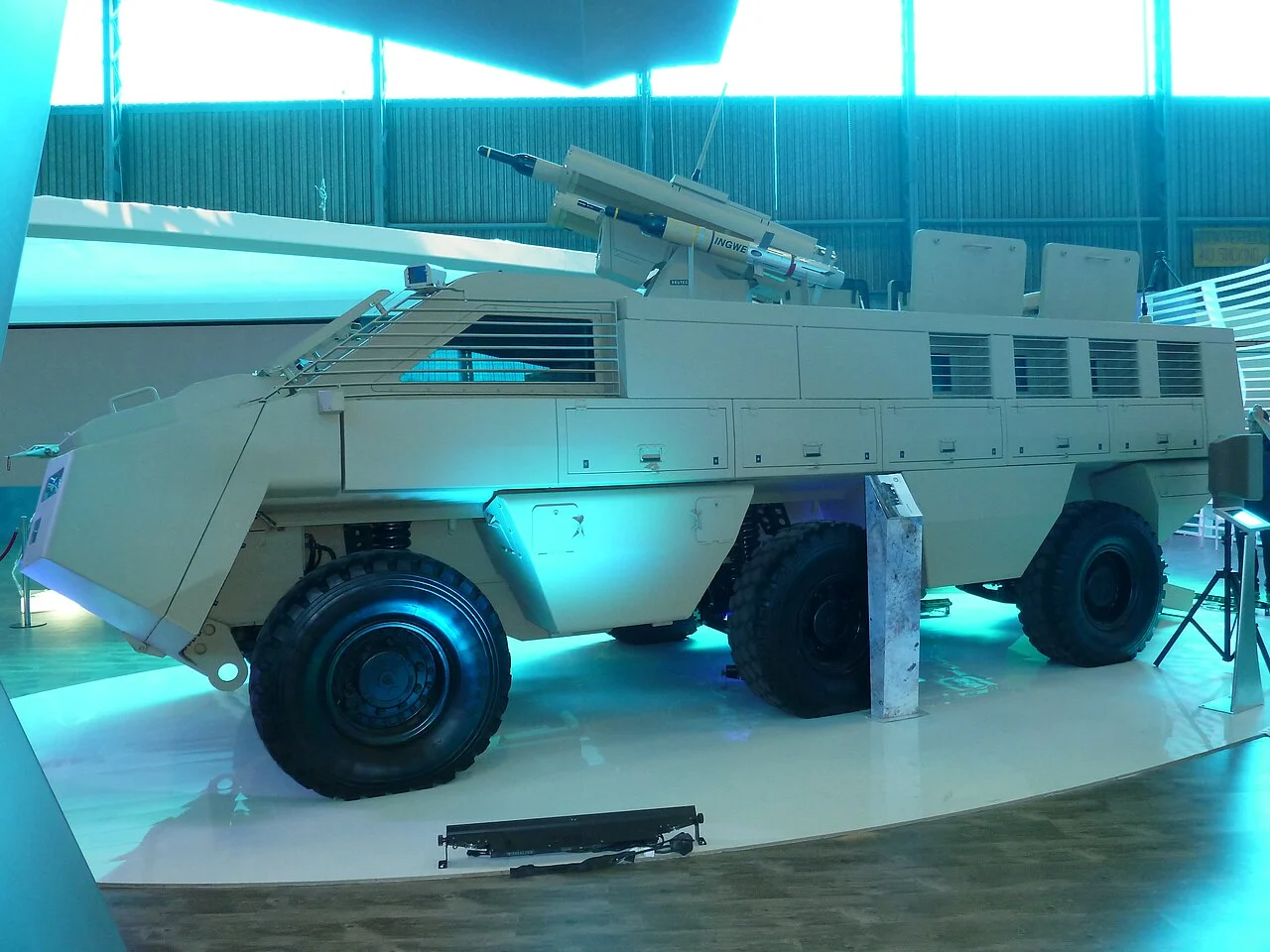
Photo: A Paramount Group Mbombe 6×6 mine-protected IFV on display at Waterkloof Air Force Base, the Pretoria venue that hosts the AAD exhibition where Paramount unveiled its V-Raven drone. Credit: JMK, CC BY-SA 3.0, via Wikimedia Commons
Paramount showed the V-Raven at Africa Aerospace and Defence 2026, held 16-18 September at Air Force Base Waterkloof, describing it as a reusable evolution of the company’s N-Raven loitering munition programme. Where the N-Raven is a single-use precision-strike system, the V-Raven is built to fly repeated missions, launching and landing vertically without a runway or catapult, according to Military Africa.
What the V-Raven offers
In its petrol-engine configuration, Paramount lists an endurance of up to 8 hours, a range of up to 1,200 km, a cruise speed of roughly 140 km/h and a communications range of up to 150 km, on a 3.6-metre wingspan and a maximum take-off weight of 65 kg. An electric variant trades range and endurance — up to 250 km and 2 hours — for a quieter acoustic signature, useful for covert overwatch closer to a target area. The initial role is intelligence, surveillance and reconnaissance, using electro-optical sensors for day and night observation and automatic target tracking; Paramount says a light-attack version able to carry precision-guided munitions is planned but still needs further testing and systems integration.
Sello Ntshiele of Paramount said the platform was “developed for the realities of the modern African battlefield,” pointing to the need for extended surveillance over large, often roadless areas. The vertical launch and recovery is the operative design choice for that market: it lets the V-Raven work from forest clearings, riverbanks or mountainous terrain where fixed-wing UAVs would need a prepared strip, a constraint that has limited ISR coverage for several African militaries operating against insurgent and criminal networks in remote terrain.
From N-Raven to V-Raven
The V-Raven builds on a platform family Paramount has been developing since at least 2021, when it first showed the N-Raven loitering munition at IDEX. That system — a 55 kg, 3.6-metre-wingspan swarming munition with a 13.5 kg warhead or sensor payload, up to 4.5 hours of endurance and a 100 km radius on its petrol variant — entered production in 2023 and was later licensed to Greece’s Hellenic Defence Systems for local manufacture as the IRIX munition, according to defenceWeb. The V-Raven shares the N-Raven’s general airframe class and vertical-launch logic but is reusable rather than expendable, reflecting demand from customers who want persistent ISR rather than a one-shot strike option.
A crowded South African drone field
The V-Raven’s debut comes as South African manufacturers compete to define the country’s unmanned-systems export offer. At the same AAD show, Milkor signed a memorandum of understanding with France’s Safran Electronics & Defense to integrate Safran optronics and navigation systems onto the Milkor 380 — currently the largest UAV designed and built in Africa, a medium-altitude, long-endurance platform Milkor says has flown more than 30 hours and 4,000 km continuously — and previewed a larger Milkor 780, reported by defenceWeb. State-owned Denel also used AAD 2026 to showcase its own unmanned aerial systems alongside the Rooivalk attack helicopter and Badger infantry fighting vehicle programmes. Paramount’s V-Raven occupies a different niche from the Milkor 380’s long-range MALE role: it is smaller, cheaper and runway-independent, competing more directly with tactical VTOL ISR drones than with strategic surveillance platforms.
Why it matters for Africa
Vertical-launch, runway-independent drones address a specific African operating problem: many militaries fighting insurgencies in the Sahel, the Lake Chad basin or Mozambique’s Cabo Delgado need persistent overhead surveillance in terrain with no prepared airstrips and limited logistics support. A system that a small forward team can launch from a clearing, rather than one that needs a runway and a support convoy, lowers the barrier to fielding organic ISR at company or battalion level rather than relying on scarce national air assets. It also strengthens South Africa’s pitch as a defence-industrial supplier to the rest of the continent — Paramount, Milkor and Denel are all marketing African-designed, African-priced alternatives to Western and Chinese systems at a moment when African defence ministries are under pressure to stretch procurement budgets further. Whether the V-Raven converts trade-show interest into contracts will depend on Paramount completing the light-attack variant and lining up the export approvals and financing that have determined the fate of comparable African UAV programmes.