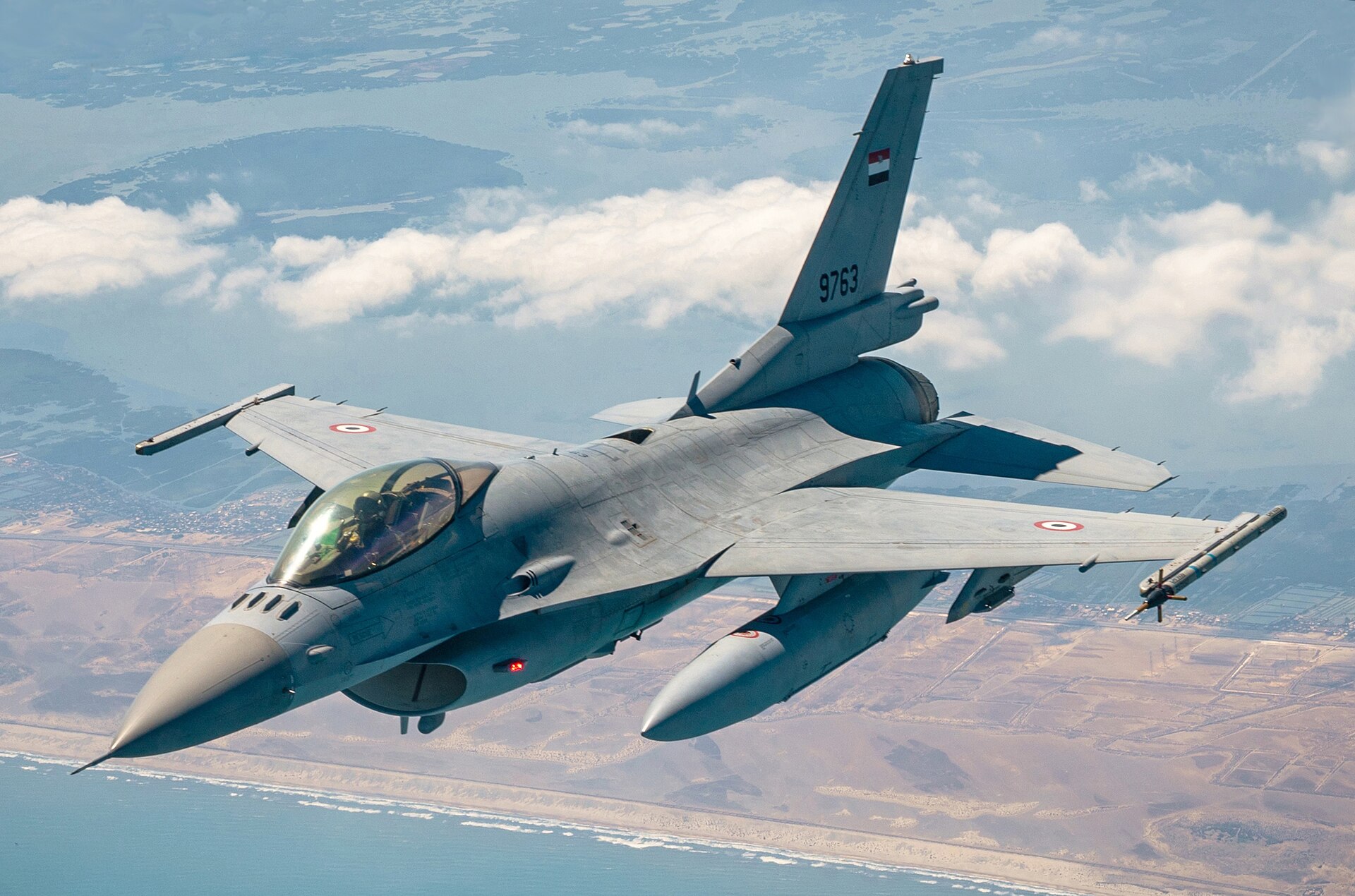
As of November 2026, the United States has not publicly approved an F-16 Viper (Block 70/72) upgrade or purchase for Egypt. L3Harris said at EDEX 2025 that Egypt had formally asked about the Viper standard. In September 2026 Military Africa reported, citing unnamed sources, that Cairo had requested new-build Block 70 jets instead. No Defense Security Cooperation Agency (DSCA) notification has been published.
What L3Harris said at EDEX 2025
According to Egypt Daily News, Travis Rohl, L3Harris’ director of international business development for the Viper Shield electronic warfare system, said at EDEX 2025 that Egypt had formally submitted a request to upgrade its aircraft and that “talks are already taking place between the Egyptian and U.S. governments”. He presented the AN/ALQ-254(V)1 Viper Shield as the best fit for Egypt “should the deal proceed”. Defensehere also reported the L3Harris pitch.
This is a company statement at a trade show, not a government announcement. No timeline was given.
The 2026 report: new jets, not upgrades
On 17 September 2026 Military Africa reported that Egypt submitted a formal request during the El Alamein 2026 airshow to buy newly built F-16 Block 70 aircraft. The outlet said Cairo officials spoke on condition of confidentiality and that an industry source judged the older Egyptian airframes too old to convert to the Viper standard. This remains an unconfirmed media report.
Egypt’s F-16 fleet in numbers
The figures below are as reported by Military Africa:
| Batch | Year | Aircraft |
|---|---|---|
| Peace Vector I | 1982 | 42 Block 15 |
| Peace Vector II | 1986 | 40 Block 32 |
| Peace Vector III | from 1991 | 47 Block 40 |
| Peace Vector IV | 1993 | 46 Block 40, assembled by TUSAŞ in Türkiye |
| Advanced Block 52 | 2010 contract | 20 Block 52, last delivered November 2015 |
The outlet puts the total fleet at 220–240 aircraft, of which 129 are older Block 15, 32 and 40 jets built between 1982 and 1995. The Peace Vector IV batch is a reminder that Turkish Aerospace has been part of Egypt’s F-16 story since the 1990s. For the continental picture, see our guide to F-16 operators in Africa.
What a Viper would add
- AESA radar: the Block 70/72 uses the Northrop Grumman AN/APG-83 radar.
- Electronic warfare: L3Harris pitches Viper Shield as an automated, fully digital EW suite.
- Airframe life: Lockheed Martin rates the Block 70 at 12,000 flight hours, per both reports above.
The missing piece is weapons. Military Africa notes that Washington has long withheld the AIM-120 AMRAAM from Egypt. A new radar without a modern beyond-visual-range missile would limit the gain, which is one reason Egypt turned to the Rafale and its Meteor missile.
What US approval would look like
Any sale or major upgrade would go through Foreign Military Sales. That normally means a public DSCA notification to Congress, listing aircraft, equipment and estimated value. None had appeared by November 2026. Until one does, any number of aircraft or price tag attached to an Egyptian Viper deal should be treated as speculation. Earlier US approvals for Egypt are listed in our overview of US–Egypt arms deals.
Bottom line
There is credible evidence of Egyptian interest, from L3Harris on the record and from a media report citing anonymous officials. There is no public approval, contract or delivery schedule. The next sign to watch is a DSCA notification.
Sources
- Egypt Daily News – Cairo and Washington in talks to upgrade Egypt’s F-16 fleet
- Defensehere – L3Harris Viper Shield for Egypt
- Military Africa – Egypt requests F-16 Block 70 (17 Sep 2026)
Featured image: Senior Airman Dominic Tyler via Wikimedia Commons, Public domain. Illustrative photo.