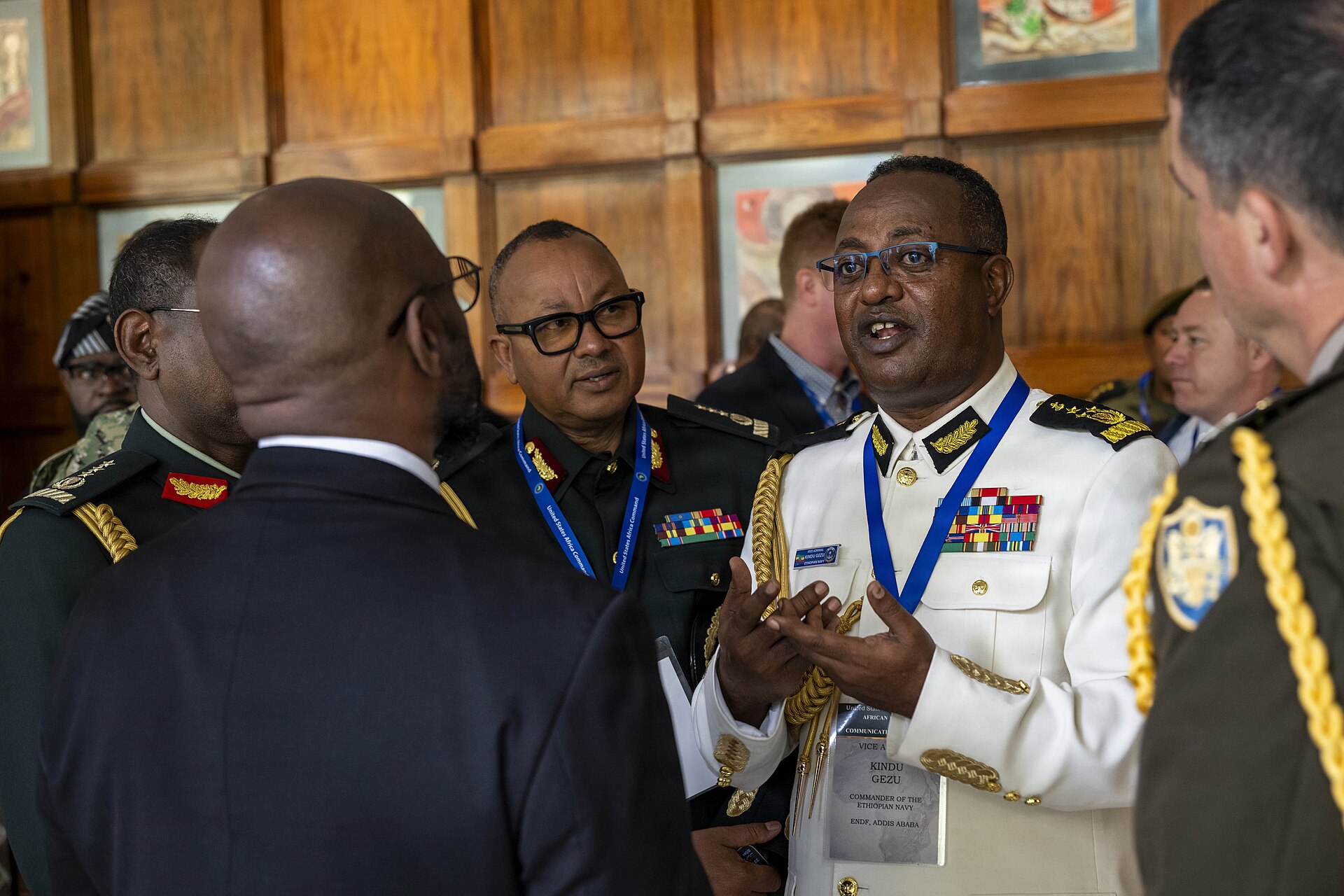
The commander of the Ethiopian Navy, Vice Admiral Kindu Gezu, has said Ethiopia will regain the Red Sea port and sea access it lost “through diplomacy, law, or other alternative”. He made the remarks at a symposium for former military and police personnel in Addis Ababa, as reported by a Sputnik Africa correspondent on 7 November. He did not say what the “other alternative” would be or name any country. Eritrea, which holds the coastline Ethiopia lost in 1993, already treats such statements by Ethiopian officials as threats to its sovereignty.
What the navy chief said
According to Sputnik Africa, Kindu described the loss of sea access as one of the tragedies of Ethiopian history. “The connection between Ethiopia and the Red Sea is not an event that emerged after the Second World War, as others may want to tell us. It has existed for thousands of years,” he said. He said the Ethiopian people and government would regain the port and sea access “lost through illegal means”. He also urged retired soldiers and police officers to inspire the current generation to support Ethiopia’s maritime claims.
Somali Report carried the same remarks on 8 November. In its account, the admiral said Ethiopia’s demand was not driven by territorial expansion or plans for military aggression, and that a solution under international law and through negotiation remained the preferred route. He nonetheless warned that Ethiopia was prepared to pursue its “historical” maritime access if talks failed. HahuPrime, which also relied on the Sputnik report, noted that he did not spell out the alternatives.
DefenceMENA could not find a transcript or report of the speech from the Ethiopian News Agency or the Ethiopian National Defense Force. The quotes above therefore rest on Sputnik Africa’s correspondent and on Somali Report. The X post that circulated the remarks in Arabic also says Kindu called Eritrea’s independence “unjust”. That wording does not appear in the reports reviewed, which quote him as saying sea access was lost “through illegal means”.
A line repeated across Ethiopia’s leadership
The remarks follow similar statements from Kindu. After a regional maritime security forum hosted by the Ethiopian Navy in Addis Ababa from 26 to 29 October, with naval officers from Yemen, Oman, Djibouti, Somaliland and Puntland, he said Ethiopia’s return to a seaport was “inevitable”, The Abay Times reported. He added that this required working “closely and through dialogue” with regional states.
Ethiopia has been landlocked since Eritrea’s independence in 1993 and relies on Djibouti for most of its foreign trade. Its January 2024 memorandum of understanding with Somaliland, which Somalia rejected, was followed by the Türkiye-mediated Ankara Declaration with Somalia in December 2024. The navy was re-established from 2018 and still has no port or base of its own on the Red Sea.
How Eritrea reads it
Asmara has made clear that it treats this rhetoric as a threat. On 2 November, Eritrea’s Ministry of Information published a compilation titled “Ethiopia’s Overtly Declared War Agenda Against Eritrea”. It lists what it presents as verbatim statements by Prime Minister Abiy Ahmed, ENDF Chief of Staff Field Marshal Berhanu Jula and other senior officials on taking sea access “through negotiations if possible and by force if necessary”, including references to the port of Assab. DefenceMENA did not find a separate Eritrean response to Kindu’s 7 November remarks.
Analysis
Kindu’s wording is carefully hedged. Law and diplomacy come first, and the “other alternative” is left undefined. Coming from a service chief, however, and alongside the statements Eritrea has catalogued, the phrase will be read in Asmara as a military option rather than a legal one. The tension is already military: DefenceMENA has covered the self-defence letters both governments sent to the UN and the Ethiopian army’s arrival at Zalambessa on the Eritrean border.
The legal route is also narrower than the rhetoric suggests. As Gebeta Media notes, neither Ethiopia nor Eritrea is a party to the UN Convention on the Law of the Sea. Even under that convention, a landlocked state’s transit rights must be agreed with the coastal state, which keeps full sovereignty. In practice, “law and diplomacy” means a deal with Eritrea, Djibouti, Somalia or Somaliland. Anything beyond that would be the “other alternative” Kindu declined to define.
What is not known
- The full text of the speech, and whether Ethiopian state media or the ENDF will publish it.
- What Kindu meant by “other alternative”, and whether the remarks reflect a change in government policy or repeat existing positions.
- Whether Eritrea will respond formally to these specific remarks.
Sources
- Sputnik Africa, “Ethiopia Vows to Restore Lost Red Sea Access Through Law, Diplomacy, or ‘Other Alternatives’: Navy Commander”, 7 November 2026: sputniknews.africa
- Somali Report, 8 November 2026: somalireport.com
- HahuPrime, 8 November 2026: hahuprime.com
- The Abay Times, 30 October 2026: abaytimes.com
- Eritrea Ministry of Information (Shabait), 2 November 2026 (official): shabait.com
- Gebeta Media, “Ethiopia, Assab and the Red Sea”: gebeta.net
- @atafmohamed3, X post, 8 November 2026 (Arabic; claim): x.com
Method: the X post was checked against the original Sputnik Africa report and two further outlets. No Ethiopian state media account of the speech was found. Eritrea’s position is taken from its Ministry of Information.