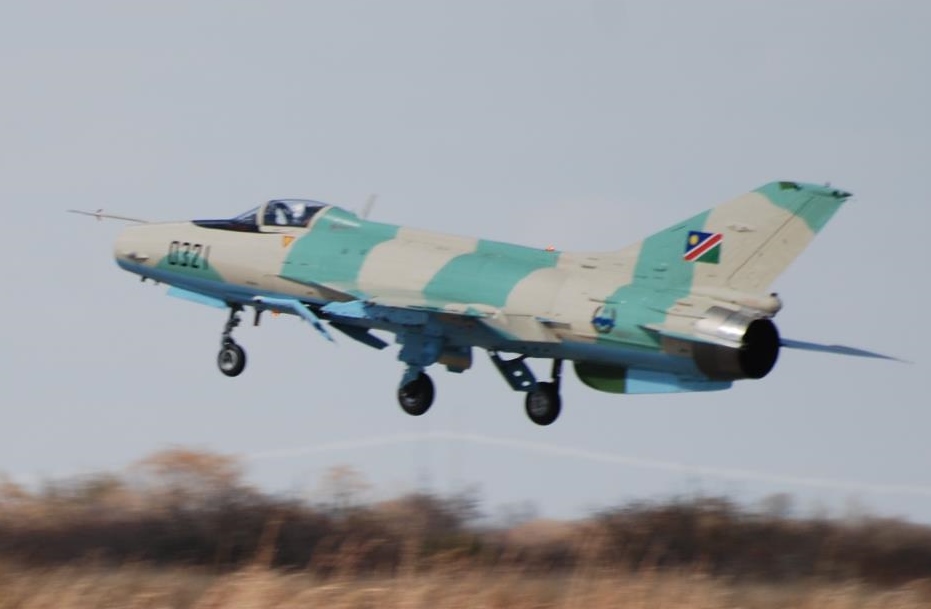
Only a handful of African air forces fly Chinese fighter jets, and most of them are ageing aircraft from the Chengdu F-7 family rather than modern multirole types. Five countries have such aircraft documented in service or recently in service: Nigeria, Zimbabwe, Namibia, Tanzania and Sudan. Nigeria also flies a small number of JF-17 fighters, a Chinese-Pakistani design. Algeria is reported to be negotiating for the J-10CE, but neither government has confirmed it. This guide lists each operator with a status label and explains why the fleet numbers should be read with care.
Methodology and data sources
The list counts countries whose air forces operate, or are credibly reported to be buying, a combat jet of Chinese design: the J-7 and F-7 family, the JF-17 and the J-10. Chinese trainers such as the K-8, light attack aircraft and armed drones are excluded, because they are covered in separate guides. DefenceMENA covers the drone side in its piece on Chinese drones in Nigeria.
Each entry carries one of four labels: in service, in service with reduced numbers, reported, or talks only. Counts come from press reports and reference works that cite Flight International and Jane’s, because the full World Air Forces directory covers 161 nations and sits behind a subscription. Rows are ordered by the documented size of the fleet, not by capability. Treat every quantity as the best public figure rather than a verified inventory.
African countries operating Chinese fighter jets: overview
| Country | Type | Documented quantity | Status |
|---|---|---|---|
| Sudan | F-7 (variants not specified) | About 20 listed in 2023 | In service, condition uncertain |
| Nigeria | F-7Ni, FT-7Ni; JF-17 Block 2 | 12 F-7Ni and 3 FT-7Ni bought; 3 JF-17 | In service |
| Tanzania | J-7G, F-7TN | 12 J-7G and 2 F-7TN ordered in 2009 | In service |
| Namibia | F-7NM, FT-7NM | 12 delivered; one badly damaged in 2021 | In service, reduced numbers |
| Zimbabwe | F-7II, F-7IIN, FT-7BZ | 12 F-7 and 2 FT-7 delivered; about 7 F-7 listed in 2022 | In service, reduced numbers |
| Algeria | J-10CE | 30 to 40 reportedly under discussion | Reported, unconfirmed |
| Egypt | J-20 or J-35 stealth fighter | None | Talks only, reported |
The quantity column mixes two kinds of figure. Where a source gives the number delivered, it is shown as delivered; where it gives a count of aircraft listed in service in a given year, the year is shown. The two cannot be added together or compared directly, and the status column is the safer guide to what each country can field today.
Top entries explained
Sudan appears first on documented numbers. Reference works citing the 2024 edition of Flight International list 20 F-7 fighters, and some Chinese ground-attack aircraft were reportedly financed by Iran in the 1990s. The country has been at war since 2023, so the serviceability of that fleet cannot be assumed. The wider inventory is covered in Sudan Air Force aircraft.
Nigeria has the most varied mix. Its F-7Ni and two-seat FT-7Ni jets were bought to replace the MiG-21 fleet, and reference works report three JF-17 Block 2 fighters delivered to Makurdi in March and inducted on 21 May of the same year, with the air force chief confirming combat use against insurgents later. Any order for 35 to 40 more JF-17 fighters is described only as potential.
Tanzania replaced its original F-7A fighters, flown in the war with Uganda in 1978 and 1979, with 12 J-7G and 2 F-7TN aircraft ordered in 2009. These carry a Chinese radar and PL-7A short-range missiles, according to reference works.
Namibia received 12 F-7NM and FT-7NM aircraft, which defenceWeb calls its only jet combat aircraft. On 15 October 2021 one F-7NM overshot the runway at Ondangwa after its brake parachute failed to deploy, and defenceWeb described airframe 0315 as most likely a write-off.
Zimbabwe took delivery of F-7II, F-7IIN and FT-7BZ aircraft, believed to include 12 delivered in 1986. A J-7 crashed near Gweru on 30 May 2025, killing a retired squadron leader who had returned as an instructor, according to Bulawayo24. Reference works list about seven F-7 fighters remaining in 2022.
Regional patterns and trends
Three patterns stand out. First, the buyers are mainly southern and eastern African states and Nigeria, acquiring Chinese fighter jets in deals dating from the 1980s to the 2000s. Second, the jets are older single-engine types of 1960s design, bought to replace ageing MiG-21 fleets or to keep a minimal jet capability.
The F-7 itself is a Chinese development of the Soviet MiG-21, which explains why it suited air forces that already had MiG-21 pilots, ground crews and weapons. Spares and upgrade support for these fleets are not itemised in the public sources reviewed.
Third, nobody in Africa operates China’s modern J-10C or J-20 in confirmed service. North Africa’s two large buyers, Algeria and Egypt, continue to buy mostly Russian and Western aircraft, as set out in Africa’s strongest air forces.
Recent changes
The main development is the reported Algerian interest in the J-10CE. A trade-press piece published in August said Algiers was negotiating for 30 to 40 aircraft plus up to five KJ-500 early-warning aircraft, with deliveries potentially from 2027, and added that neither government has confirmed the package. The article does not name its original sourcing, so the report should be treated as unverified. Algeria’s current fleet is in Algerian Air Force aircraft.
Egypt is a different case: press reports describe talks over Chinese stealth fighters after its hope of buying US F-35 jets went unmet, as covered in Egypt and Chinese stealth fighters. No contract has been announced. Elsewhere, J-10 export operators named in reference works are Pakistan and Uzbekistan, and none are in Africa.
What the numbers do not show
Fleet counts say little about readiness. Several of these air forces have lost aircraft to accidents, small fleets can drop to a few airworthy jets, and spare parts and weapons depend on supplier support. The Namibian and Zimbabwean incidents show how a loss of one or two airframes changes a fleet of about ten.
Namibia shows how far sources can diverge. DefenceWeb refers to a dozen F-7NM and FT-7NM aircraft, while reference works citing Flight International list 6 F-7NM and 2 FT-7NM as active. Both can be right if one counts deliveries and the other counts airworthy jets, which is why the table separates the two.
Counts also mix delivered, in-service and remaining aircraft, and Flight International figures are estimates. The method excludes jets that were retired earlier, and it counts the JF-17 as Chinese because China co-developed it, even though Pakistan builds it. A stricter definition would remove Nigeria’s three JF-17 fighters from the table.
Frequently asked questions
Which African countries operate Chinese fighter jets?
Nigeria, Zimbabwe, Namibia, Tanzania and Sudan have documented F-7 family fighters, and Nigeria also has JF-17 aircraft. Algeria is reported to be negotiating for the J-10CE, and Egypt is reported to have discussed stealth fighters, but neither deal is confirmed.
Does any African air force fly the J-10?
No confirmed African operator exists. Algeria is reported to be negotiating for 30 to 40 J-10CE fighters, with deliveries possibly from 2027, but neither Algiers nor Beijing has confirmed the deal. The sources name only Pakistan and Uzbekistan as J-10 export operators.
Is the JF-17 a Chinese fighter?
The JF-17 was developed jointly by Pakistan and China and is built in Pakistan. Nigeria is the only African operator reported, with three aircraft inducted in May after delivery to Makurdi. Whether to classify it as Chinese depends on the definition used, which is why this list flags it separately.
Why are the fleets so small?
Most African buyers purchased a dozen or fewer aircraft to replace MiG-21 fleets or keep a basic jet capability. Accidents, ageing airframes and limited spares have reduced several fleets since delivery, so remaining numbers are lower than the quantities originally delivered.
Sources
- defenceWeb, Namibian F-7 fighter badly damaged in runway overshoot
- The Aviator Africa, Namibian Air Force F-7NM crash at Ondangwa
- Bulawayo24, Zimbabwe veteran pilot killed in Gweru jet crash
- Defence Security Asia, Algeria’s reported J-10CE deal
- Flight International, World Air Forces directory
- South China Morning Post, Pakistan and the J-10C