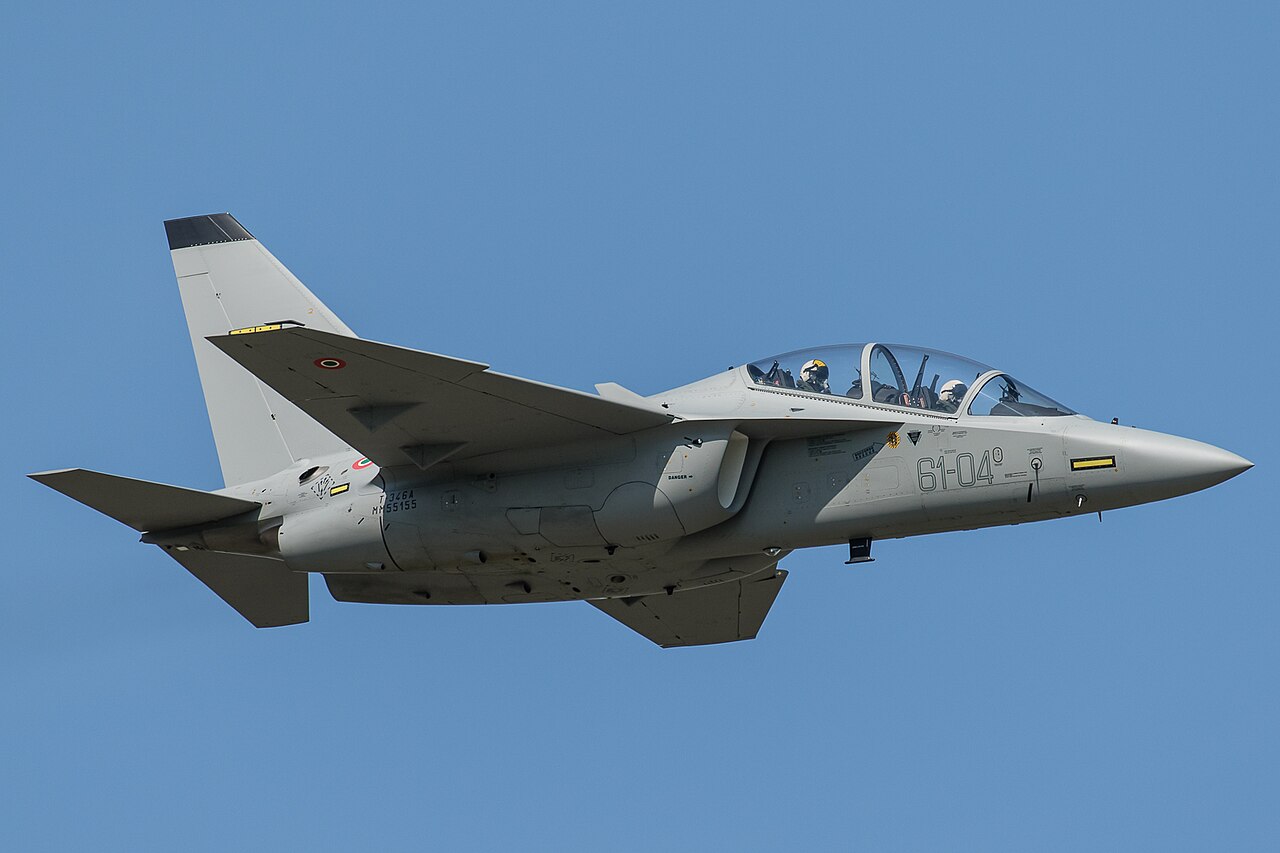
Leonardo’s M-346 pairs advanced jet training with light combat capability, and the M-346 specifications that matter most are two Honeywell F124 turbofans, a top speed near Mach 0.95 and seven hardpoints on the FA version. The type is in service with air forces in Europe, the Middle East and Asia, and Nigeria is its first African customer. This guide sets out the verified data, the variants, the operators with the quantities that can be supported, and where the numbers remain uncertain.
Leonardo M-346: Overview and Development History
The M-346 Master is a twin-engine advanced jet trainer designed to prepare pilots for fourth and fifth-generation fighters. It was developed by Alenia Aermacchi, now part of Leonardo, and the Italian Air Force designates its aircraft T-346A. Israel, which bought 30, calls its version Lavi.
Three variants matter for buyers. The basic M-346 is the trainer. The M-346FT adds multirole training functions, and the M-346FA is the fighter-attack version, equipped with a radar and a wider weapons range. Nigeria has ordered the FA.
Leonardo markets the FA as a dual-role platform for lead-in fighter training, close air support, battlefield air interdiction and tactical reconnaissance (Quwa). That dual use is why the aircraft appears both in trainer competitions and in light-attack discussions across Africa.
M-346 Specifications and Performance
The M-346 specifications below describe the M-346FA as reported for the Nigerian order. Published performance numbers differ slightly between outlets, mostly because of rounding and unit conversion, so ranges are shown where two reports disagree.
| Parameter | Reported value |
|---|---|
| Engines | Two Honeywell F124-GA-200 turbofans |
| Top speed | Near Mach 0.95 (over 1,065 km/h) |
| Service ceiling | 13,716 m (45,000 ft) |
| Range, internal fuel | About 1,925 to 1,960 km, depending on the report |
| Range with external tanks | About 2,550 km |
| Hardpoints | Seven (three under each wing and one on the centreline) |
| External load | More than 2,000 kg |
| Radar | Grifo-346 multimode fire-control radar |
The Nigerian configuration also carries a defensive aids suite, a tactical datalink and a helmet-mounted display (Military Africa). A centreline hardpoint can take an optional cannon pod.
One report lists nine external hardpoints for the same aircraft. Quwa, defenceWeb and the later Military Africa report all give seven, and this guide uses seven.
Armament and Capabilities
Beyond the basic M-346 specifications, the FA is defined by its weapons. For air-to-air work, the reported weapons are the AIM-9 Sidewinder and the IRIS-T short-range missiles. For precision strike, the list includes the AGM-65 Maverick and guided bombs. Gun pods in 20 mm or 12.7 mm are also listed (Quwa).
These are options, not a statement of what each customer has bought. A trainer-only customer may never integrate a radar or missiles, which is why the quantity of FA aircraft in service is a separate question from the quantity of M-346 airframes. For the wider market of radar-equipped fighters, see the guide to African fighter jets with AESA radar.
Operationally, a jet of this class is a stepping stone between turboprop trainers and frontline fighters. It also gives smaller air forces a light-attack option for counter-insurgency, where a supersonic fighter would be costly to fly. Its limits are payload and endurance compared with a full multirole fighter.
Operators and Numbers in Service
Operator totals are the weakest part of public M-346 data. Orders, options, deliveries and losses are reported at different times, and some operators do not publish fleet sizes. The table separates figures backed by a source opened for this guide from figures that rest on reference listings.
| Operator | Quantity and status | Basis |
|---|---|---|
| Nigeria | 24 M-346FA ordered; first three passed factory acceptance | defenceWeb, Quwa |
| Israel | 30 aircraft (Lavi), delivered from 2014; last three arrived in July 2016 | Times of Israel |
| Greece | 10 delivered; at least four more under consideration | OnAlert, September 2025 |
| Poland | First two arrived at Deblin in November 2016 | FlightGlobal; total is a reference-listing figure |
| Italy | Largest user; reference listings give inconsistent totals | Reference listing |
| Singapore | 12, flown at Cazaux Air Base in France | Reference listing |
| Qatar | 6 | Reference listing |
| Turkmenistan | 6, a mix of FA and other versions | Reference listing |
| Austria | 12 M-346FA on order, options for 12 more; deliveries planned from 2028 | Reference listing |
| Canada | 6 M-346T Block 20 ordered, options for 6 more | Reference listing |
The Greek air force uses the M-346 at its flying training centre at Kalamata, where it replaced the T-2 Buckeye. The 10th aircraft was delivered to 362 Training Squadron, and the first graduates have moved on to Rafale, F-16 and Mirage 2000-5 squadrons (OnAlert). The same report says German and British trainees also use the centre. No quantitative training data is published.
Israel paid for its aircraft with Israeli technology, including satellites and surveillance aircraft, in a deal worth about $1 billion signed in 2012 (Times of Israel). The arrival of the Lavi began the retirement of the Skyhawk trainers.
Nigeria: The First African Customer
Nigeria ordered 24 M-346FA in a deal worth about $1.4 billion (roughly 1.2 billion euros), confirmed by the presidency in May 2023. Deliveries are planned in four tranches of six for two squadrons, and the package includes weapons, support equipment, spares, training and a 25-year maintenance arrangement. The jets are to replace the Alpha Jet, L-39ZA and MB-339AN.
The schedule has slipped. Leonardo’s sales chief said in April 2024 that the first six were due by the end of that year, and the date moved by about a year and a half. The first three aircraft passed factory acceptance testing at Venegono Superiore between 29 June and 9 July, and the air force announced it on 27 July. defenceWeb reported that the first three are expected in Nigeria by December (defenceWeb).
No delivery schedule has been published for the remaining 21 aircraft, and no home base or squadron designation has been confirmed. Thirteen Nigerian personnel began maintenance training in Italy on 13 July. More detail is in the site’s reports on Nigeria’s M-346FA delivery and on the maintenance training in Italy.
Operational Record and Combat Use
None of the sources reviewed documents combat use of the M-346 by an operating air force. Its record is a training one, in Italy, Israel, Poland, Greece, Singapore and elsewhere. Armed trials with AIM-9L missiles were reported in late 2017, but trials are not operations.
For African buyers, that matters. The FA’s counter-insurgency potential is a manufacturer claim and a design intent, not a demonstrated record. The first real test will come when Nigeria’s aircraft enter service and are tasked against armed groups.
The aircraft has also drawn export scrutiny in Italy and Britain over sales to Israel after the Gaza war. Leonardo has said the aircraft were delivered under earlier agreements and comply with export law, according to reference-work reporting of Reuters coverage that this guide could not check at source.
How It Compares With Rival Systems
The M-346 competes with the KAI FA-50, the Yak-130 and the Turkish Aerospace Hurjet in the lead-in trainer and light-attack class. Published figures for these aircraft vary by configuration and customer, so this guide does not set M-346 specifications against theirs. A like-for-like table would need the same radar, fuel and weapons fit on each type.
The practical differences are procurement ones. The M-346 offers a long NATO-linked training pedigree, with Italy, Greece, Poland and Singapore as users. Rivals are often priced and financed differently, and some come with domestic industrial offsets. Where an air force already flies Western fighters, the M-346’s training syllabus can be a deciding factor.
African air forces also weigh engines and support. The F124 is a US-origin engine, which can bring export-control steps, and Leonardo’s 25-year support package for Nigeria is the kind of arrangement buyers now ask for. For regional air power context, see the ranking of the strongest air forces in Africa.
Frequently Asked Questions
What are the main M-346 specifications?
The M-346FA is powered by two Honeywell F124-GA-200 turbofans, reaches about Mach 0.95, and has a service ceiling of 13,716 m. Reported range is about 1,925 to 1,960 km on internal fuel. It has seven hardpoints carrying more than 2,000 kg, and a Grifo-346 radar.
Which countries operate the M-346?
The operators of the M-346 include Italy, Israel, Poland, Greece, Singapore, Qatar and Turkmenistan, with Austria and Canada reported as buyers and Nigeria as the African customer with 24 on order. Quantities vary by source, and several are reference-listing figures not confirmed by the operators.
Does any African country fly the M-346?
Not yet at the time of writing. Nigeria has ordered 24 M-346FA, and the first three passed factory acceptance testing. defenceWeb reported that they are expected in Nigeria by December. No other African operator or confirmed African prospect appears in the sources reviewed.
Has the M-346 been used in combat?
No combat use by an operating air force is documented in the sources reviewed. The aircraft is used mainly for training, and weapon trials, such as the AIM-9L firings reported in late 2017, are separate from operations. The FA variant is marketed for close air support and interdiction.
Sources
- Quwa: Nigerian Air Force clears first Leonardo M-346FA aircraft for delivery
- defenceWeb: Nigerian Air Force completes factory acceptance testing for first M-346FA jets
- defenceWeb: First Nigerian M-346s to be delivered by year-end
- Military Africa: Nigerian Air Force completes first set of M-346FA jets for delivery
- Military Africa: Nigerian Air Force technicians train in Italy on M-346FA
- Times of Israel: Final plane in billion-dollar deal with Italy lands in Israel
- OnAlert: M-346 training at the Hellenic Air Force flying school
- FlightGlobal: Poland’s first M-346 trainers arrive in Deblin