Milkor: Inside South Africa’s Grenade Launcher and Drone Maker



Milkor is a privately owned South African manufacturer whose 40 mm grenade launcher has become one of the most widely fielded infantry weapons in the world, and whose Milkor 380 drone has now entered service with an undisclosed Middle East customer. This profile tracks the company’s weapons, armoured vehicles, drones and patrol craft, and the confirmed status of its South African, regional and export orders as of October 2026.
DEFENCE AFRICA | Company profile & product gallery | Data as of October 2026
Milkor (Pty) Ltd was established in 1980 by Andries Piek and is headquartered in Hennopspark, Centurion, in South Africa’s Gauteng province. Unlike Denel, the state-owned giant that dominates South Africa’s defence-industrial base, Milkor has stayed privately held for its entire history, building its reputation on a single weapon: the MGL, a six-shot 40 mm revolving-cylinder grenade launcher first ordered by the then-South African Defence Force in 1983. According to Milkor’s own figures, cited in a 2025 Military Africa report, the 40 mm launcher family has since been adopted by security forces in more than 60 countries.
Since 2017, the company has pushed beyond small arms into land, air, sea and cyber systems, a diversification that mirrors the path Paramount Group took a decade earlier. That expansion now spans an armoured personnel carrier line, the Vanguard mine-protected vehicle, the Milkor 380 medium-altitude long-endurance (MALE) drone, and the Commander patrol craft built through Milkor’s UAE operation. The common thread across the catalogue is an export orientation: Milkor markets its products first to African, Gulf, Latin American and Asia-Pacific militaries seeking capable but comparatively affordable platforms, rather than to NATO’s larger procurement budgets.
The company’s growth has tracked South Africa’s wider defence-export push. Armscor and industry representatives said in September 2026 that the country’s defence sector exported more than R10 billion in equipment over the preceding year and is targeting further growth rather than consolidation. Milkor’s grenade launchers, long the most consistent South African defence export by country count, and its newer drone and vehicle lines sit squarely inside that push.
Key facts
- Founded in 1980 in Centurion, South Africa; privately owned throughout its history (Milkor company history, via Wikipedia)
- Milkor’s 40 mm grenade launcher family is in service in more than 60 countries, per the manufacturer (Military Africa, March 2025)
- South Africa’s SANDF took delivery of the last of 370 SuperSix Y4 launchers, ordered under a November 2017 Armscor tender, by 28 February 2019 (Army Recognition, 2019)
- The Milkor 380 drone made its maiden flight in September 2023 and completed first deliveries to an undisclosed Middle East customer by October 2026 (ITWeb, 14 October 2026)
- Diversified from weapons into land, air, sea and cyber systems from 2017 onward (Wikipedia)
1. Milkor MGL / Y2 — the launcher that built the company’s name
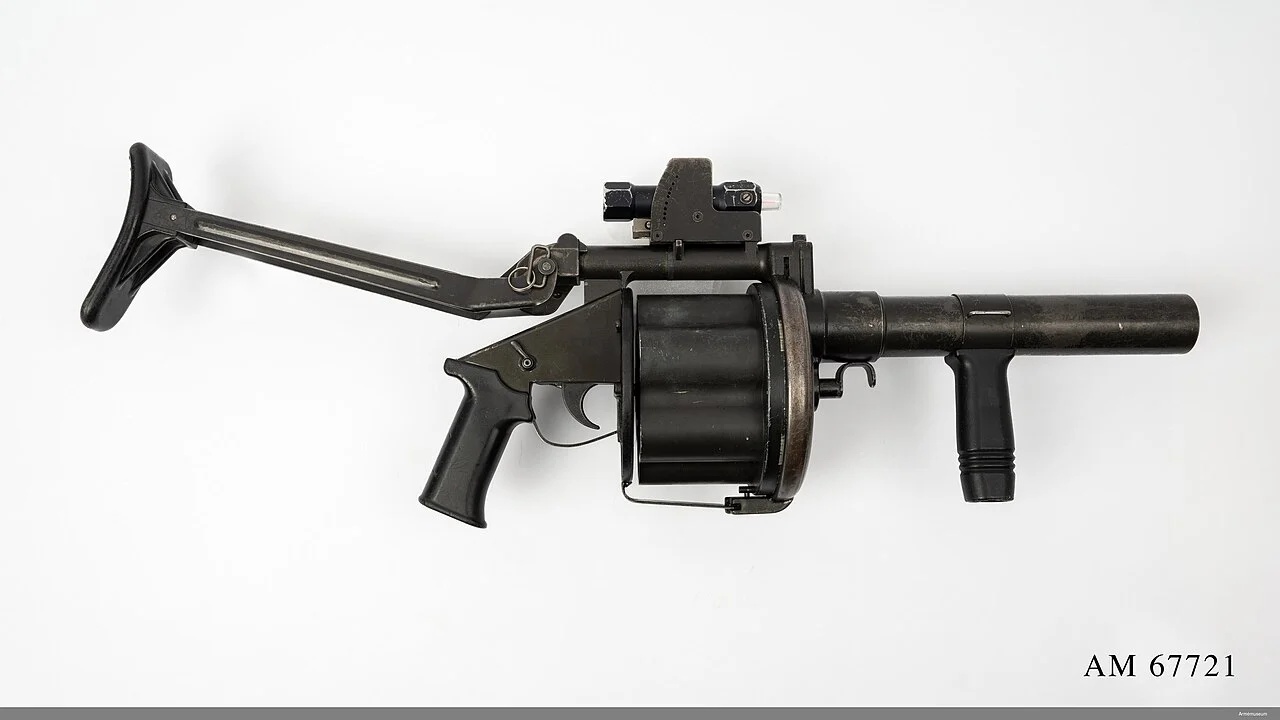
The MGL is a 40×46 mm, six-round revolving-cylinder grenade launcher weighing 5.3 kg, with an effective range of around 400 m and a rapid-fire rate of roughly three rounds per second, according to its published specifications. The then-South African Defence Force adopted the weapon, designated the Y2, in 1983, and it has remained in South African service ever since — status: operational. Rwanda’s armed forces reportedly acquired around 70 units in 1992, also listed as operational, and the design went on to be licence-built or cloned in Bulgaria (as the Arsenal MSGL), Croatia (as the RBG-6) and India (by Ordnance Factory Tiruchirappalli), while the separate company Milkor USA built the related M32 for U.S. forces. Wikipedia’s operator list, compiled from open reporting, also names Taiwan, Brazil, Pakistan, Colombia and more than a dozen other states. The weapon’s six-shot, swing-out cylinder design remains distinctive among grenade launchers, most of which are single-shot or pump-action, and that combination of volume of fire and relatively low unit cost is the main reason it has outcompeted larger Western manufacturers’ launchers across Africa, Asia and Latin America.
2. SuperSix Y4 Multi-Range Grenade Launcher — extending the MGL’s reach
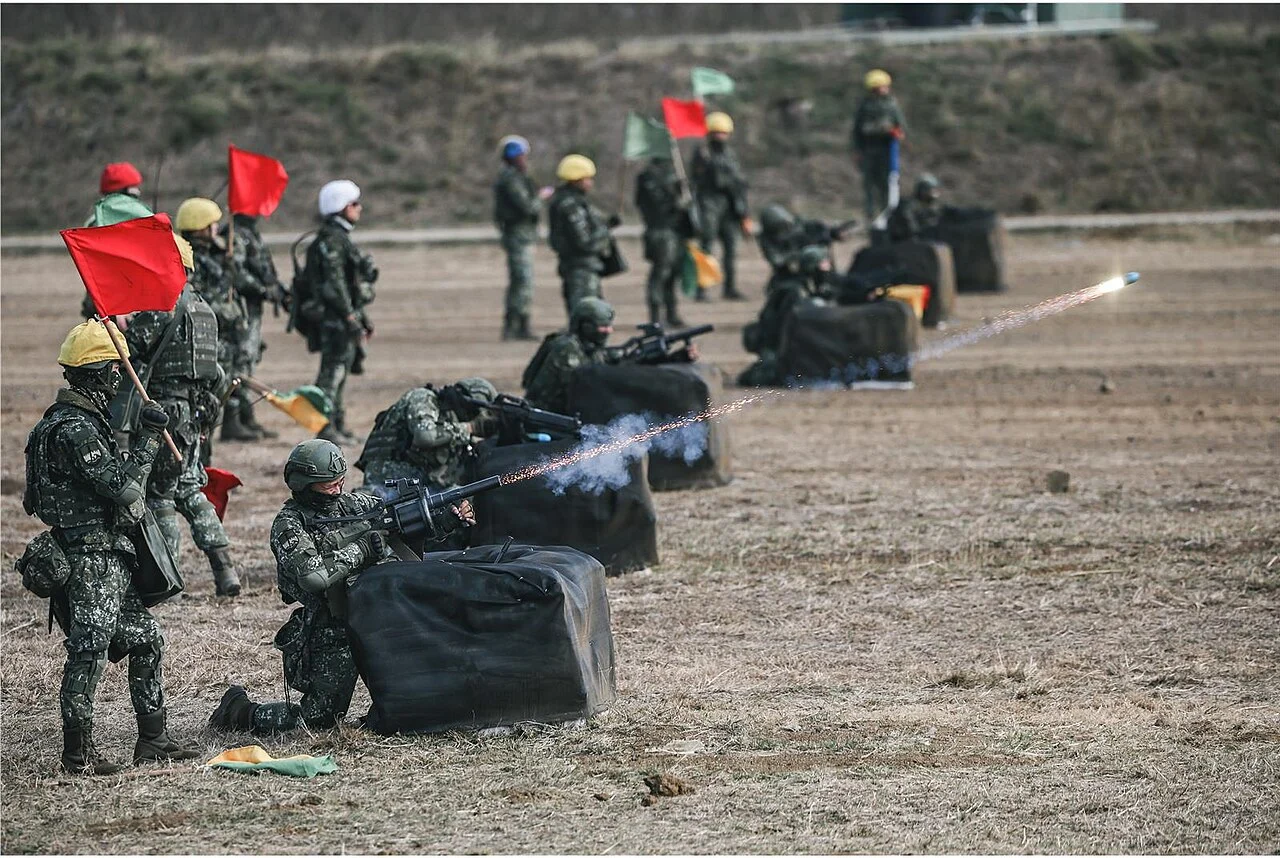
The SuperSix Y4 keeps the MGL’s six-shot cylinder but is chambered for the longer 40×51 mm medium-velocity round alongside the standard 40×46 mm grenade, pushing published maximum range out to 800–1,200 m, roughly double the baseline MGL. South Africa’s National Defence Force ordered 370 of the launchers under an Armscor tender issued in November 2017, and Milkor delivered the final batch of 180 units on 28 February 2019 — status: delivered. More recently, Milkor demonstrated the SuperSix to the Colombian Army at Tolemaida in March 2025, where Military Africa reported the company pitched it as an upgrade over the US-made Mk 19, M79 and M203 launchers already in Colombian service — status: reportedly under negotiation, with no contract announced as of this writing. Colombia is a relevant market for Milkor beyond that demonstration: the state arsenal Indumil already produces the original MGL design under licence for the Colombian armed forces.
3. Milkor 380 — a Rotax-powered MALE drone aimed at export customers
The Milkor 380 is a medium-altitude, long-endurance unmanned aircraft with an 18.6 m wingspan, powered by a 135 hp Rotax 915iS piston engine, that first flew in September 2023. Published maximum take-off weight figures vary by source and year: EDR Magazine reported 1,300 kg in 2025, while South Africa’s Business Day reported a maximum weight of 1.4 tonnes in October 2026; some company materials have cited figures up to 1,500 kg. Milkor advertises endurance above 30 hours, though independent flight-test confirmation of that figure was not found. The airframe carries five hardpoints, two per wing and one on the centreline, which EDR Magazine reported in 2025 can be configured for intelligence, surveillance and reconnaissance sensors or, depending on the customer and applicable export approvals, guided bombs, light air-to-ground missiles or loitering munitions.
ITWeb reported on 14 October 2026 that the Milkor 380 is now operational with an undisclosed Middle East customer, with the company confirming first deliveries complete but declining to name the operator, the country, the quantity delivered or whether the aircraft has seen combat use — status: delivered, to an unnamed operator. Closer to home, South Africa’s Business Day reported on 17 October 2026 that Milkor is still seeking an order from its own SANDF for the type — status: reportedly under negotiation, with no confirmed domestic order as of this writing. Milkor has also pursued Gulf sales: Breaking Defense reported in February 2024 that the company held a Saudi manufacturing permit that would allow local assembly if a sale went through, and said it was in talks with senior Saudi officials and separately with the UAE, though no contract had been announced at that time and no update was found for 2026 — status: reportedly under negotiation. Milkor is also working to integrate French sensor technology into the type: the company signed an MoU with Safran at the AAD 2026 exhibition in Pretoria to explore fitting the Milkor 380 with Safran optronics and navigation systems, which DefenceMENA covered separately.
4. Vanguard — a 19.5-tonne mine-protected vehicle unveiled at AAD 2024
The Vanguard is Milkor’s newest armoured vehicle, unveiled at the Africa Aerospace and Defence exhibition in 2024. Army Recognition reported a gross vehicle mass of 19,500 kg and a tare mass of 15,500 kg, with STANAG 4A and 4B blast protection (rated to survive a 10 kg anti-tank mine blast under any wheel, track or the hull) and STANAG Level 3 ballistic protection against 7.62×51 mm armour-piercing rounds. The vehicle carries a crew of two plus eight passengers, is powered by a 336 kW (450 hp) engine giving a power-to-weight ratio of about 22 kW per tonne, and is rated for a 100 km/h top speed and 900 km operational range. Milkor markets the Vanguard in infantry-fighting-vehicle, armoured-personnel-carrier, border-patrol, ambulance and command-vehicle configurations, with mounts for remote weapon stations, manned turrets, smoke launchers and electronic-warfare or signals-intelligence fits. No operator or export contract for the Vanguard had been publicly confirmed at the time of writing.
5. Milkor 4×4 armoured personnel carrier — a V-hulled vehicle for African conditions
Milkor’s 4×4 APC, first launched in 2018, predates the Vanguard and remains the company’s volume armoured-vehicle offering. According to Milkor’s own contractor profile hosted on Army Technology, the vehicle has a V-shaped hull engineered to deflect landmine blasts away from occupants, B7 ballistic protection, and seating for 10 to 12 troops. Milkor has marketed desert and internal-security (anti-riot) variants of the platform. No specific national operator for the 4×4 was independently confirmed in available reporting at the time of writing, though the company has said the design was conceived with African terrain and threat profiles as the baseline requirement before being offered more broadly.
6. Commander — a 16-metre patrol craft from Milkor’s UAE yard
Milkor’s naval line is smaller than its land and air catalogue, built through the company’s UAE-based operation. The Commander is a 16-metre high-speed patrol craft intended for coastal patrol, search and rescue, and maritime security missions, with a crew of up to four and sleeping and living quarters built into the hull for patrols of up to five days, according to Milkor’s Army Technology-hosted profile. No specific operator or contract for the Commander had been publicly confirmed at the time of writing. The naval line remains the least-developed part of Milkor’s portfolio relative to its weapons and land-systems business, but it illustrates the same pattern as the rest of the catalogue: a private South African manufacturer building export-oriented hardware across every domain rather than specialising in one, in contrast to Denel’s more consolidated land-and-air focus or Paramount Group’s vehicle-led export model.
Why it matters for Africa
Milkor is one of the clearest examples of an African-founded company competing on the global arms market rather than serving only domestic or regional demand: the MGL’s adoption across dozens of countries happened because it offered African and other developing-world buyers volume of fire and durability at a lower unit cost than Western six-shot alternatives, not because of political alignment or aid financing. That affordability logic now extends to the Milkor 380, offered as a cheaper, locally producible alternative to Western or Chinese MALE drones for African and Gulf air arms that want organic ISR and strike capability without the technology-transfer restrictions that sometimes accompany NATO-sourced platforms. The Vanguard and 4×4 vehicle lines speak to sustainment economics as much as protection levels: African militaries operating mixed, often older vehicle fleets have consistently favoured manufacturers, including Paramount and Denel as well as Milkor, that can supply spares and field support locally rather than through a distant original equipment manufacturer. Milkor’s own uncertainty over securing a SANDF order for its flagship drone, even as export customers elsewhere take delivery, also underlines a recurring theme on this site: South Africa’s defence industry increasingly sells more readily abroad than it re-equips its own armed forces.
Sources
- Wikipedia – Milkor (Pty) Ltd
- Wikipedia – Milkor MGL
- Army Recognition – Milkor Supplied SANDF With Y4 SuperSix Grenade Launchers (2019)
- Military Africa – Milkor Demonstrates SuperSix Grenade Launcher to Colombian Army (March 2025)
- ITWeb – SA-Made Milkor Combat Drone Deployed in Middle East (14 October 2026)
- Business Day – Global Tensions Are Good News for Arms Makers (17 October 2026)
- EDR Magazine – Expodefensa 2025: Milkor 380, Africa’s MALE Powerhouse Takes Flight
- Breaking Defense – South Africa’s Milkor Ready to Locally Produce 380 UCAV for Saudi Arabia (February 2024)
- Army Recognition – AAD 2024: Milkor’s New Vanguard APC Challenges Conventional MRAPs
- Army Technology – Milkor company and product profile