France and Chad Sign Defence Declaration of Intent: What It Covers and What It Doesn’t



France and Chad signed a declaration of intent on defence cooperation in Paris on Tuesday 13 October 2026, nearly two years after N’Djamena ended its defence agreements with France and ordered French troops out. The two defence ministers signed the text at the Élysée Palace, with Presidents Emmanuel Macron and Mahamat Idriss Déby Itno looking on. The Élysée says it gives a framework for cooperation in training, expertise, industry and technology. It is not a new defence treaty, it does not announce French troops returning to Chad, and the full text has not been published.
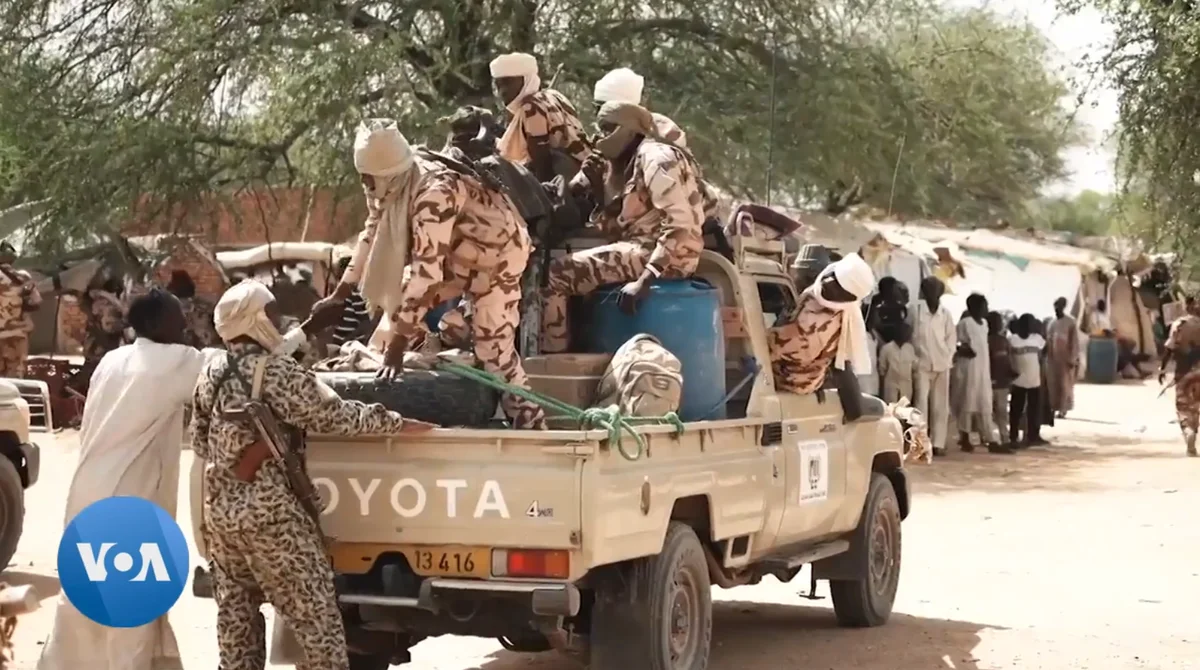
Featured image: Chadian soldiers at the Chad–Sudan border in May 2023. Photo: Henry Wilkins and Arzouma Kompaoré (Voice of America), via Wikimedia Commons, public domain. File photo.
What was signed
- Signatories: France’s Minister of the Armed Forces and Veterans, Catherine Vautrin, and Chad’s Minister of the Armed Forces, Veterans and War Victims, General Issakha Malloua Djamouss, according to Chadian outlet Tchadinfos and RFI.
- Type of document: A declaration of intent on cooperation in defence capabilities. A declaration of intent sets out what both sides plan to do; it is not a binding treaty.
- Stated scope: The Élysée said the text will “structure and develop bilateral defence cooperation, notably in the areas of training, expertise, industry and technology”, and help “support the capability development of the Chadian armed forces in innovative fields” (AFP). It gave no further detail.
- What is missing: RFI noted that the content of the declaration was not released. Tchadinfos said no concrete arrangements were given, and that the declaration is not a new military cooperation agreement or an announcement that French forces will return.
Macron wrote on X: “We are taking a new step forward and formalising the strengthening of our defence partnership, in line with a renewed relationship. We are building a partnership based on mutual respect and practical cooperation for the benefit of our peoples.”
How the relationship broke down, and how it came back
In November 2024 Chad ended its defence cooperation agreements with France, ending a security arrangement that, as AFP describes it, had lasted six decades. The last French forces left Chadian territory in early 2025. The departure followed French military withdrawals from Mali, Burkina Faso and Niger after coups there between 2020 and 2023, as those juntas moved closer to Russia (AFP).
The thaw has been gradual:
- January 2026: Déby was received at the Élysée. According to the French presidency, security cooperation resumed at the start of the year, notably military training, equipment supplies and intelligence sharing (AFP). RFI also pointed to a quiet resumption of intelligence cooperation.
- May 2026: The two presidents met again at a summit in Nairobi (AFP).
- September 2026: A France–Chad business forum was held in Paris, which RFI linked to Chad’s wish to broaden the relationship beyond security.
- 13 October 2026: The declaration of intent was signed during Déby’s working visit to Paris.
A French diplomatic source told AFP before the visit that the two countries had been operating in a “legal vacuum” since the old agreements ended: “Cooperation has resumed, but all of this now needs to be formalised.” The declaration is the first step in that direction.
What each side wants
N’Djamena asked for a relationship “between equals” based on “mutual respect”, RFI reported, and for cooperation that goes beyond security alone. Those words now appear in French official messages, including Macron’s post. RFI’s reading is that both sides gain: Chad needs help watching long and unstable borders, and France wants to keep a foothold in a Sahel where its former partners have turned to Russia.
Chad’s security picture explains the interest. It borders Sudan, where the war between the army and the Rapid Support Forces has pushed refugees across the frontier, as well as Libya, Niger, the Central African Republic, Cameroon and Nigeria, with jihadist groups active around Lake Chad. For the kind of equipment African armies have bought to watch such frontiers, see our guide to border surveillance systems for African land borders. Chad’s Sahel neighbours have also turned to new suppliers, as in Niger’s Bayraktar TB2 purchase.
What to watch
- Whether the two ministries publish the text or sign follow-on agreements that set out training programmes, equipment deliveries or industrial projects.
- Whether the “innovative fields” the Élysée mentioned turn into concrete capabilities, such as drones, surveillance or communications. Nothing specific has been announced.
- Whether any formal status-of-forces arrangement follows. For now, both governments describe a cooperation framework, not a French deployment.
Sources
- RFI: Tchad-France, une « déclaration d’intention » signée pour relancer la coopération militaire (14 October 2026)
- Tchadinfos: Tchad-France, signature d’une déclaration d’intention sur la coopération en matière de défense (13 October 2026)
- AFP via Modern Ghana: Macron, Chad’s Deby seek to rebuild defence partnership (13 October 2026)
- Mediapart (news wire): La France et le Tchad structurent leur coopération de défense « sur des bases renouvelées » (13 October 2026)
Evidence note: The scope of the declaration comes from the Élysée as reported by AFP, RFI and Tchadinfos; the text itself has not been published. The quote on the “legal vacuum” is from an unnamed French diplomatic source cited by AFP. Updated as of 16 October 2026, 07:20 GMT.