Kenya’s Counter-Terrorism Bureau, US Africa Command and the British High Commission in Nairobi have jointly launched a trilateral hotline for the public to report suspected terrorist activity, the first platform of its kind in East Africa. The toll-free line and an accompanying online portal go live on 15 October, giving Kenyans an anonymous channel to pass information on al-Shabaab and other threats directly to security agencies.
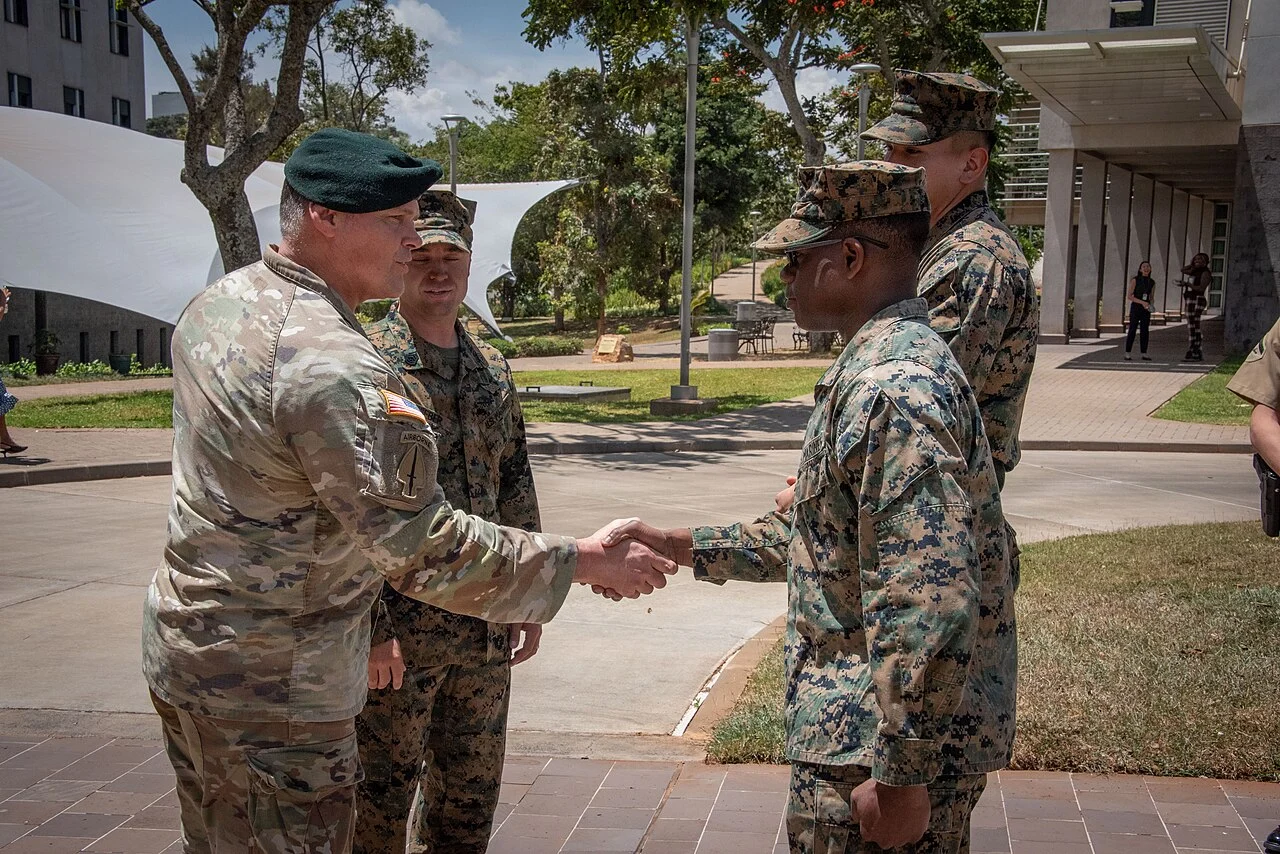
Photo: A U.S. Africa Command deputy commander meets security personnel in Nairobi, Kenya, as US-Kenya counterterrorism cooperation continues. Credit: U.S. Department of War photo by Maj. Mahalia Frost, Public domain, via Wikimedia Commons
How the hotline works
The service, reachable toll-free on 0800-900-900 from any phone in Kenya, was announced on 19 September by Kenya’s Counter-Terrorism Bureau alongside US Africa Command and the British High Commission. Callers and online users can report suspicious activity or known terrorist movements anonymously, feeding tips into Kenyan-led investigations rather than into a foreign-run system. Kenya’s Prime Cabinet Secretary Musalia Mudavadi framed the platform as a way to formalise a role the public already plays informally, saying the launch “elevates the community to serve as partners in countering terrorism.”
AFRICOM’s Maj Gen Shane P. Morgan said the three partners “want the same thing: a safer, more secure, Horn of Africa,” while the command’s Carla Benini argued the platform targets al-Shabaab’s reliance on silence in the communities it operates around: “Terrorist groups like al-Shabaab thrive on silence. This platform breaks it.” The UK’s Ed Barnett said Britain was “proud to support Kenya in launching this Kenyan-owned capability,” a framing officials have leaned on to present the tool as sitting under Kenyan authority rather than run by outside partners.
Part of a wider security push
The hotline lands alongside other recent moves to tighten coordination between Kenya and its Western partners on counter-terrorism. Kenya Defence Forces and US personnel completed their first installation-wide combined base-defence exercise at Camp Simba, Manda Bay, in late August, testing force-protection procedures six years after an al-Shabaab raid killed three Americans at the same base, as DefenceMENA has reported. US Africa Command has also stepped up its own strike tempo against al-Shabaab in neighbouring Somalia this year, and Nairobi continues to contribute troops to the African Union Support and Stabilization Mission there.
A public tip line is a comparatively low-cost addition to that effort. Unlike an exercise, an aircraft delivery or a new radar, it requires no major capital outlay from any of the three governments, but it depends entirely on public trust — in the anonymity promise, and in the belief that a call will actually be followed up — to generate usable intelligence rather than noise.
Why it matters for Africa
Kenya has spent much of the past decade absorbing al-Shabaab attacks that originate across its northern and coastal borders with Somalia, from the 2013 Westgate Mall siege to repeated raids on police posts and villages in Lamu and Garissa counties, where Manda Bay itself sits. Community-sourced tips have historically been Kenya’s most reliable early-warning tool against an insurgency that moves easily across a long, thinly policed frontier, and formalising that channel with international backing gives it more consistent funding and technical support than ad hoc arrangements typically attract.
For the wider region, the model is one other East African states — from Uganda to Tanzania to Mozambique, all of which face their own violent extremist movements — could plausibly copy at low cost. Whether it succeeds will depend less on the technology than on whether Kenyans trust the anonymity guarantee enough to actually use it, a test the programme’s Kenyan ownership framing is explicitly designed to help pass.
Sources
Related: Kenya and US Forces Run First Full Base-Defence Exercise at Manda Bay and DefenceMENA’s Kenya desk.