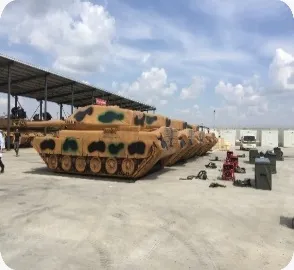
SAHTEP is an inflatable decoy set that makes a convincing copy of an M60T tank and a ZMA armoured combat vehicle, not only to the eye but also to radar and thermal sensors. Developed by İzmir-based TDU Savunma Sistemleri for the Turkish Land Forces under a programme run by Türkiye’s Presidency of Defence Industries (SSB), it reflects one of the clearest lessons of drone-era warfare: the cheapest way to protect an armoured unit is often to make the enemy shoot at something else.
Photo: Presidency of Defence Industries (SSB), Türkiye.
What is SAHTEP?
SAHTEP stands for Şişirilebilir Sahte Hedef Seti, Turkish for inflatable decoy target set. According to SSB, the decoys are designed to mislead the enemy and make it waste its resources, in particular by appearing as real equipment to aerial reconnaissance, satellite imagery, radar and a range of air assets. Each set contains two full-size decoys: one M60T main battle tank and one ZMA, the tracked armoured combat vehicle of the Turkish Land Forces.
The choice of vehicles is deliberate. The M60T, Türkiye’s heavily modernised version of the M60 with a 120 mm gun, and the ZMA are both found in large numbers in Turkish armoured formations, so decoys of these two types blend naturally into real unit layouts. An enemy drone operator or imagery analyst looking at a position cannot easily tell which of the tanks and carriers is real.
Key specifications
| Manufacturer | TDU Savunma Sistemleri A.Ş. |
| Programme authority | Presidency of Defence Industries (SSB) |
| User | Turkish Land Forces Command |
| Requirement | 25 sets, each with one M60T tank decoy and one ZMA decoy |
| Visual signature | One-to-one appearance with the real M60T and ZMA |
| Radar signature | Yes |
| Thermal signature | Yes |
| Inflation | Manual and automatic |
| Material | Suitable for long-term use |
| Status (SSB, Sept 2026) | Contract negotiations ongoing |
Why radar and thermal signatures matter
A decoy that only looks right in daylight is easy to defeat. Modern reconnaissance relies on synthetic aperture radar, which sees through cloud and darkness, and on thermal cameras carried by drones and aircraft, which pick out the heat of engines and hulls. A plain inflatable shape shows up as a cold, radar-transparent object and gives itself away. SSB’s specification requires SAHTEP to reproduce both a radar signature and a thermal signature, so the decoy responds to those sensors the way a real armoured vehicle would.
The other two requirements are practical. Manual and automatic inflation means a crew can set a decoy up in minutes, deflate it and move it with the unit, so the deception picture can change as often as real positions do. Material rated for long-term use means the sets can stay deployed through weather and repeated handling rather than serving as single-use props.
TDU has built up experience in this field. At IDEF 2023 the company displayed an inflatable decoy of the BMC Kirpi armoured vehicle, and a company representative told Janes that TDU decoys were already in use with the Turkish Armed Forces. Its portfolio also includes inflatable aircraft decoys such as an F-16, along with camouflage and radar-protection nets. SAHTEP applies that expertise to the heavier end of the land inventory.
The SSB programme and status
The Land Forces Command has asked for 25 sets, and SSB’s September 2026 programme sheet states that contract negotiations with TDU are continuing. That makes SAHTEP the newest of the land-vehicle projects on SSB’s list, but it fits a consistent approach: alongside new platforms such as the ALTAY tank and upgrades such as the ZMA with the NEFER turret, SSB is investing in the low-cost measures that keep those platforms alive on the battlefield.
The economics are hard to argue with. An anti-tank guided missile or a loitering munition can cost far more than an inflatable decoy, and a real tank costs many times more again. Every munition an adversary spends on a decoy is one that does not hit a real vehicle, and every hour its analysts spend checking false targets slows its targeting cycle.
Who operates it?
SAHTEP is being procured for the Turkish Land Forces Command. With the contract still under negotiation, there are no export operators. TDU’s decoy range, however, is offered to foreign customers, and the company has said it sells dummy targets to armed forces beyond Türkiye.
Can SAHTEP go to Africa?
Few products are as easy to justify for African armies. Armed drones have spread rapidly across the continent, from the Sahel to the Horn of Africa, and our review of electronic warfare in Africa shows how quickly the contest between sensors and countermeasures is developing. Ground forces facing an adversary with drones need ways to hide and confuse, and decoys are among the cheapest.
The vehicle types in SAHTEP also match African inventories closely. Egypt, Morocco and Tunisia all operate M60-series tanks, and all three, along with several other armies, run M113-family carriers closely related to the ZMA. A decoy set modelled on those shapes would blend into their formations with little or no change. Egypt has already shown interest in the field by developing its own decoys, which suggests the concept is well understood in North African staffs.
For other African armies, TDU’s ability to produce decoys of different vehicles, including the Kirpi that already serves with several African forces, opens a path to tailored sets. Light, easy to transport and simple to operate, inflatable decoys suit armies that cannot afford to lose scarce armoured vehicles.
Frequently asked questions
What does SAHTEP stand for?
SAHTEP is short for Şişirilebilir Sahte Hedef Seti, meaning inflatable decoy target set. It is produced by TDU Savunma Sistemleri for the Turkish Land Forces.
What does a SAHTEP set contain?
Each set contains a full-size M60T tank decoy and a ZMA armoured combat vehicle decoy, with visual, radar and thermal signatures. The Land Forces require 25 sets.
Is SAHTEP in service?
As of September 2026, SSB reports that contract negotiations are ongoing. TDU’s other decoys, such as its Kirpi decoy, have been reported in Turkish service.
Why would an African army buy decoys?
Decoys force an adversary to waste drones, missiles and reconnaissance time on false targets, at a fraction of the cost of a real vehicle, which matters as armed drones spread across Africa.
Related: ZMA with NEFER turret · Turkish systems in African service