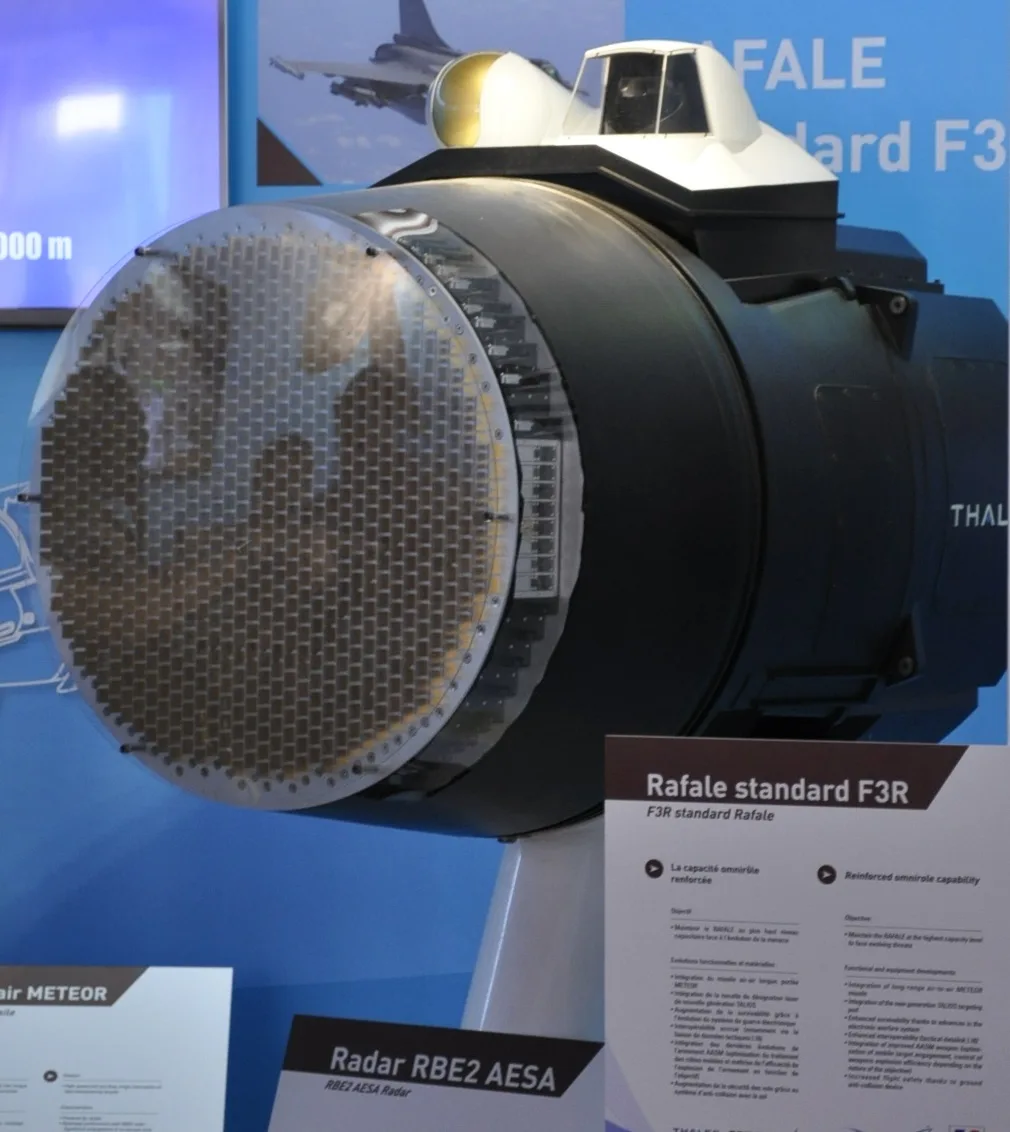
Egypt is the only African country with a confirmed, operational fleet of fighters carrying an active electronically scanned array (AESA) radar: its Dassault Rafales use the Thales RBE2 AESA. Algeria is reported to have received its first Russian Su-57E fighters, whose N036 radar is also AESA, but Algiers has not officially confirmed the delivery. Morocco’s 25 F-16 Block 72s, with the Northrop Grumman APG-83 AESA, are under contract but not yet delivered; the first aircraft flew in the United States in October 2026. Most other African fighters, including Algeria’s and Ethiopia’s Su-30 and Su-35 types, use passive electronically scanned (PESA) or mechanically scanned radars.
Photo: The Thales RBE2 AESA radar antenna, the radar fitted to Egypt’s Rafales, on display. Credit: Tiraden, CC BY-SA 4.0, via Wikimedia Commons.
Why AESA matters
An AESA radar uses hundreds or thousands of small transmit/receive (T/R) modules spread across a fixed antenna. Each module generates and receives its own signal, and the radar steers its beam electronically by changing the phase of each module rather than by moving a dish. This is called beam steering, or beamforming. It lets one radar track several targets, scan the ground and the air at the same time, and keep working if some modules fail.
A PESA radar also steers its beam electronically, but it uses a single transmitter feeding a passive array. A mechanically scanned radar physically moves its antenna. In practice, AESA radars are more reliable and harder to detect and jam than older types, and they are now the standard for new fighters.
Quick answer, verified 3 November 2026
- Confirmed AESA fighters in service: Egypt (Rafale, RBE2 AESA)
- Reported, not officially confirmed: Algeria (Su-57E, N036 AESA)
- Under contract, not delivered: Morocco (25 F-16 Block 72 and upgrade of 23 Block 52+ to F-16V, APG-83 AESA)
- PESA fighters: Algeria (Su-30MKA, Su-35), Ethiopia (Su-35, first aircraft handed over October 2026)
- Mechanically scanned radars: most other African fighters, including Nigeria’s JF-17 Block II and South Africa’s Gripen C/D
| Country | Fighter | Radar | Radar type | Status |
|---|---|---|---|---|
| Egypt | Rafale EM/DM | Thales RBE2 AESA | AESA | In service; 24 ordered 2015, 30 more 2021 |
| Algeria | Su-57E | N036 Byelka | AESA | Reported delivered; not officially confirmed |
| Morocco | F-16C/D Block 72 | AN/APG-83 SABR | AESA | Under contract; first flight October 2026; not delivered |
| Algeria | Su-30MKA | N011M Bars | PESA | In service |
| Algeria | Su-35 | N035 Irbis-E | PESA | Reported in service from 2025 |
| Ethiopia | Su-35 | N035 Irbis-E | PESA | First aircraft handed over 28 October 2026 |
| Morocco | F-16C/D Block 52+ | AN/APG-68(V) | Mechanical | In service; F-16V upgrade under contract |
| Egypt | F-16, MiG-29M/M2 | APG-68 / Zhuk-ME | Mechanical | In service |
| Nigeria | JF-17 Block II | KLJ-7 family | Mechanical | In service |
| South Africa | Gripen C/D | PS-05/A | Mechanical | In service |
Egypt: the Rafale’s RBE2 AESA
Egypt was the Rafale’s first export customer. It ordered 24 aircraft in 2015 and, according to a Dassault Aviation press release of 4 May 2021, 30 more, which would bring the fleet to 54. Thales supplied the RBE2 AESA radar as part of the 2015 package, as reported by Military Aerospace, and Aviation Week reported that later Egyptian aircraft are specified to the F3R standard, which also uses the RBE2 AESA. DefenceMENA’s Egypt Rafale fleet file covers weapons and deliveries. One open question is whether the Meteor long-range air-to-air missile has been cleared for Egypt’s Rafales. Open sources disagree, and DefenceMENA does not count it as a confirmed Egyptian capability.
Algeria: Su-57E, reported but not confirmed
Algerian state media named Algeria as the Su-57’s first export customer in February 2025, according to The War Zone. In November 2025, Russia said two Su-57s had been delivered to an unnamed foreign customer. In February 2026, Defense News and The Aviationist published footage consistent with Su-57s flying over Algeria. The Su-57’s N036 radar is an AESA system with a nose array and additional side arrays. Algiers has not made an official delivery announcement, so DefenceMENA labels this capability reported. Details: Algeria’s Su-57 fleet. Algeria’s larger Su-30MKA fleet uses the N011M Bars PESA radar (Algeria’s Su-30MKA fleet).
Morocco: AESA on order
In March 2019, the US approved the sale of 25 new F-16C/D Block 72s to Morocco and the upgrade of 23 existing Block 52+ jets to F-16V standard. Both use the AN/APG-83 Scalable Agile Beam Radar (SABR), an AESA. Lockheed Martin announced on 6 October 2026 that Morocco’s first Block 72 had made its first flight in Greenville, South Carolina. No delivery date was given, and reporting points to 2027. Until delivery, Morocco’s fighters fly with the mechanically scanned APG-68. More: Morocco’s F-16 fleet.
Ethiopia and the PESA Su-35
Ethiopia received its first Su-35s in Moscow on 28 October 2026, according to Aviation Week, The Aviationist and defenceWeb. The handover was two aircraft, although Prime Minister Abiy Ahmed announced 12. The Su-35’s N035 Irbis-E is a PESA radar with a long published detection range, not an AESA. Background: Ethiopia’s Su-35 delivery.
Nigeria and South Africa
Nigeria’s three JF-17s are Block II aircraft with the mechanically scanned KLJ-7. The KLJ-7A AESA is associated with Pakistan’s newer Block III jets, according to Quwa and The Diplomat (JF-17 family explained). South Africa’s Gripen C/D fleet uses the mechanically scanned PS-05/A (How many Gripens does South Africa have?).
Turkish example
Türkiye is developing its own fighter AESA, ASELSAN’s MURAD, for F-16 modernisation and later for its national combat aircraft. It is covered in MURAD AESA radar. No African customer for MURAD has been announced.
Frequently asked questions
Which African country has AESA radar fighters?
Egypt, with its Rafales. Algeria’s Su-57E is reported but not officially confirmed, and Morocco’s F-16 Block 72s are on order.
Does the Su-35 have an AESA radar?
No. The Su-35 uses the N035 Irbis-E, a passive electronically scanned array (PESA).
What is the difference between AESA and PESA?
Both steer the beam electronically. An AESA has many individual transmit/receive modules, while a PESA uses one central transmitter feeding a passive array.
Does Nigeria have AESA radar?
Not on its fighters. Nigeria’s JF-17 Block II jets use the mechanically scanned KLJ-7.
Sources
- Dassault Aviation, 4 May 2021 – Egypt orders 30 additional Rafale
- Military Aerospace – Egypt Rafale with Thales systems
- Aviation Week – Egypt eager for next batch of Rafales
- The War Zone – Algeria says it is the Su-57’s first export customer
- Defense News, 10 February 2026 – Russian stealth jets in North Africa
- The Aviationist, 11 February 2026 – Algeria’s first Su-57E
- Lockheed Martin, 6 October 2026 – First flight of Morocco’s first F-16 Block 72
- Aviation Week – Ethiopia takes delivery of Su-35s
- defenceWeb – Ethiopia receives first Su-35s
- Quwa – KLJ-7A AESA for JF-17
- The Diplomat, April 2018 – JF-17 to be upgraded with Chinese radar
Method: radar fits come from manufacturers and official sale notifications. Fleet status comes from DefenceMENA’s verified fleet files and defence press. Reported deliveries without government confirmation are labelled as such.
Last verified: 3 November 2026